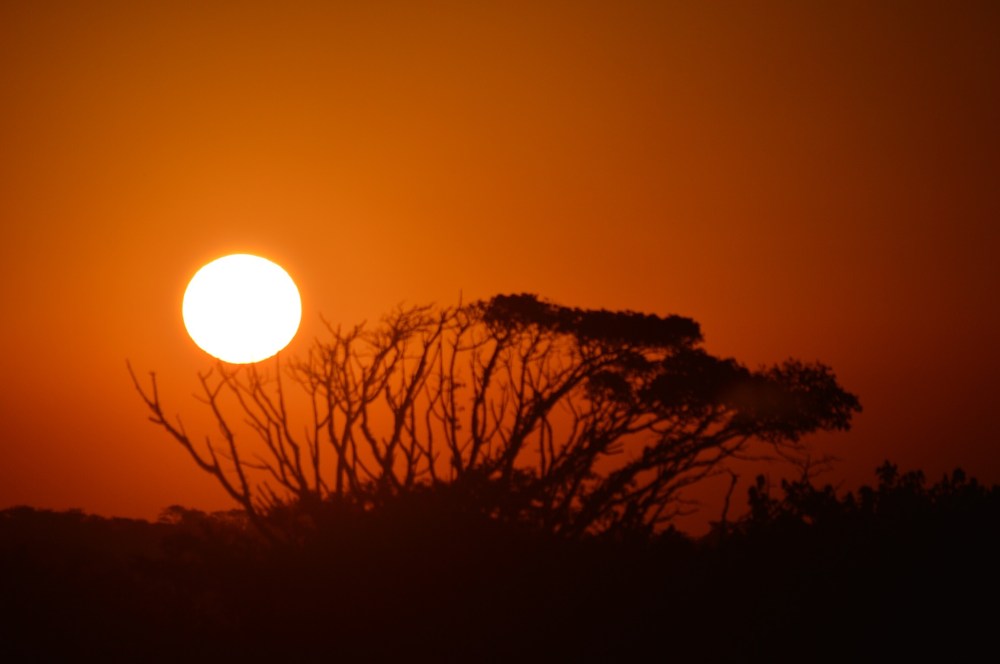
Alright, alright, alright! Let’s get this show on the road!
First off, it’s has been a crazy past few weeks! It’s been awesome and busy and epic. So sorry it’s taken this long to tell you all about it!
So, here goes. Last I left you, I had just gotten back from my first vacation, my trip to eSwatini for the Bushfire music festival. That was a great trip filled with friends and new social experiences. I have now returns from my second vacation, this one very different. This was family and nature. That’s right… family. My parents came to visit me!
On the way: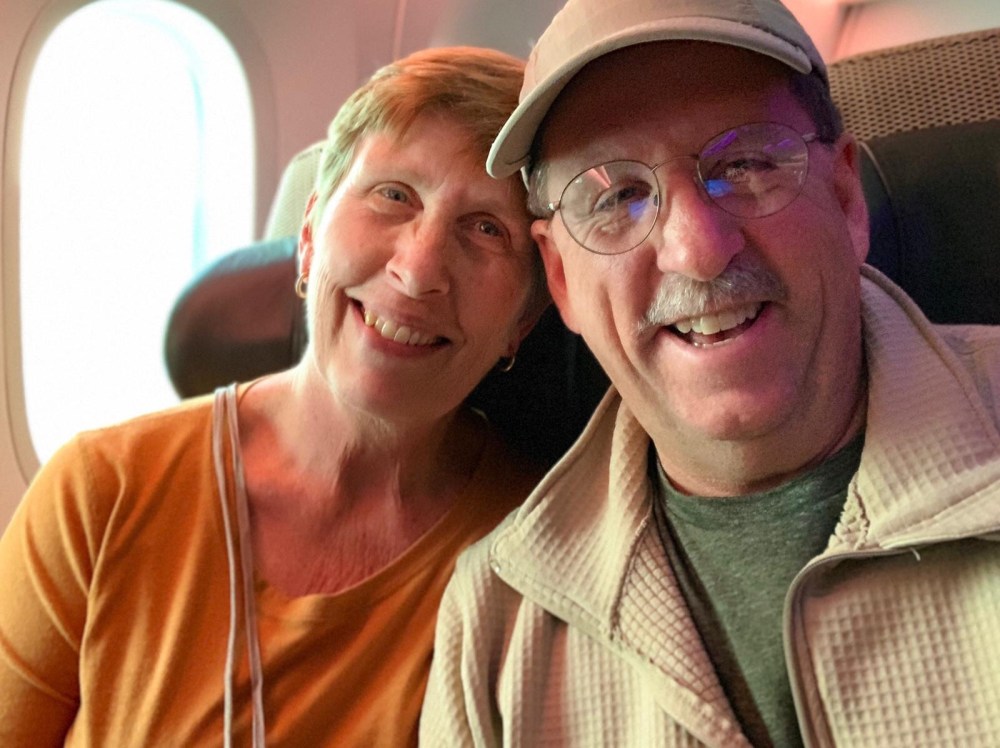
They came about a week and a half after school closed for our six week long winter break (yes, for all you Northern Hemisphere folks who might have forgotten, it is now the middle of winter here and it’s cold!). Unfortunately the week in between, I went to a Peace Corps workshop. The workshop itself was great, all about starting projects in our communities and working with out counterparts. The unfortunate part was that I apparently caught the bug that another volunteer had and by the time I got home, I was incredibly sick. So by the time I made my way to meet my parents in Maseru, I was running a very high fever and didn’t have any appetite whatsoever. Thank you PC doctor who checked me out while I was in town and gave me antibiotics and cough drops. Big help! Anyway, I wish I could say I was running and screaming when I saw my parents for the first time in nine months, but unfortunately I was having trouble speaking above a whisper. Oh well!
We met in Maseru and stayed the night. I got I hear all about their adventures having driven from Johannesburg that day. This was an adventure, because poor Dada has never driven on the left side of the road before and Jo-burg traffic is hair raising for the natives. But they made it!
The next day we drove up into the mountain, away from the traffic of Maseru, which was a relief for Dada. The scenery is spectacular and Mama never let her camera out of her hands. She was taking pictures of everything, from the mountains to the numerous goats we passed in the other lane. It was nice for me to get a reminder of how fascinating this place is, something I used to think everyday and that I now take a bit for granted. We made it to Thaba-Tseka (Ta-ba tsay-ka), the largest town in my patch of nowhere. This is where we would be staying for the night, but we weren’t done with the day yet. We stayed in town just long enough for Mama to buy a kobo (the local traditional wearable blanket) and fill up on petrol, then we left the paved roads behind. Down to the river and then up and up and up and up some more. I don’t know if I’ve mentioned, but I have one of the highest elevation sites of any PCV in country. Fun fact: I have to pop my water bottle open every time I make the trip between my village and town otherwise the pressure change makes it leak and get everything wet. Moving on, we made it to my village in one piece, which is something of an accomplishment since the road here is rather horrific at times and even though we were driving a 4-wheel drive in a road daily driven my junker taxis, Dada wasn’t sure we make it. We did. He just needed to get used to the roads.
Home sweet home: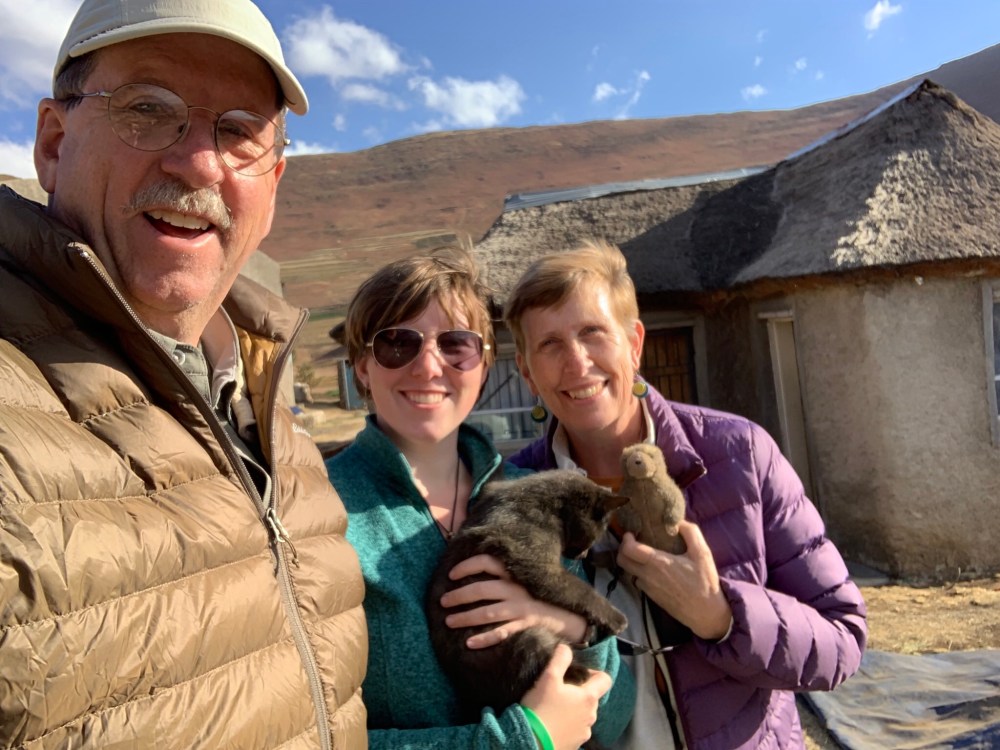 Took my parents to school (and I bundled in Mama’s new kobo because I was sick and it was cold!):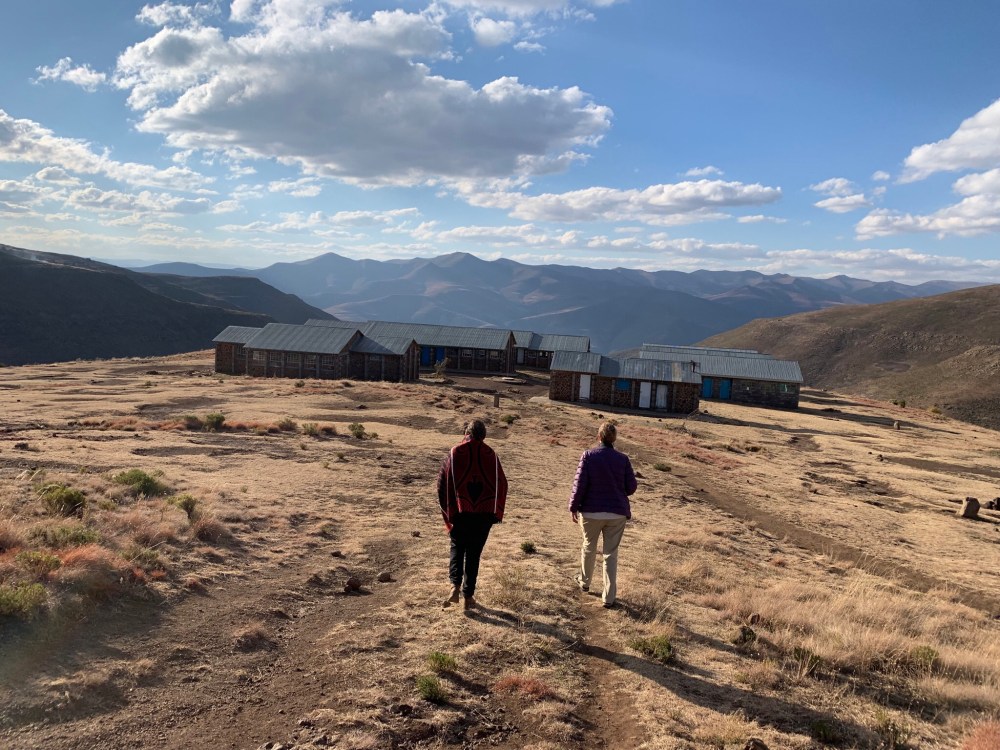
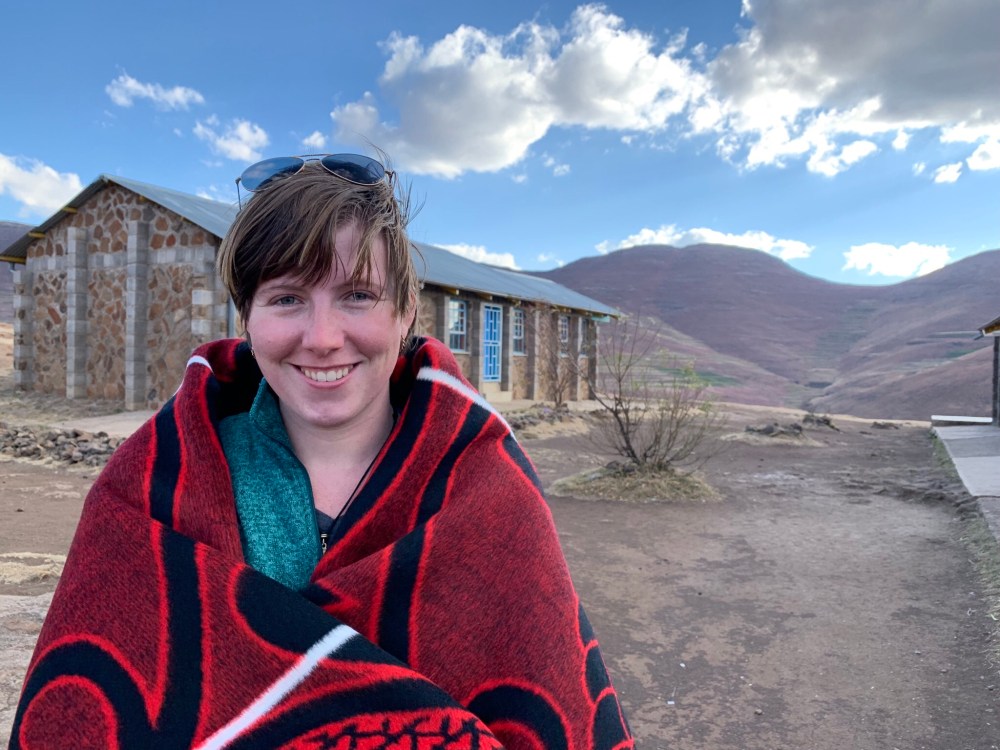
My parents got to meet some of my host family and my cat. I made them lunch, which was a thrill since Dada has been trying to picture my kitchen ever since I moved here. Now he knows! We didn’t stay long, because we still had three hours on that dirt road to drive before we got back to Thaba-Tseka and the hotel there. It was a very long day with a lot of driving. Turns out that was the theme of the trip.
We made it to Thaba-Tseka and crashed at the hotel, leaving nice and early the next day. We made a last minute decision to drive a road I hadn’t been on before to get to our next destination. A few volunteers live on the road and I had heard some horror stories but it was also the most direct route and would take us past one of Lesotho’s most famed views- Katse Dam. One of the largest pieces of Lesotho’s economy is the export of water. Katse Dam is the largest dam in the country and also holds back the largest body of water in the country. Lesotho is not known for lakes and obviously, it has no coastline to speak of, so this was the most water I’d seen in one place in months. Very exciting. Now about those horror stories about the road. Poppycock! Clearly none of those volunteers had ever been on my road. This was very pleasant in comparison. We enjoyed the drive quite a lot, even more so after we got the dam and the road down the mountains from there were paved. And the pass itself was breath taking, full of steep cliffs and grand vistas.
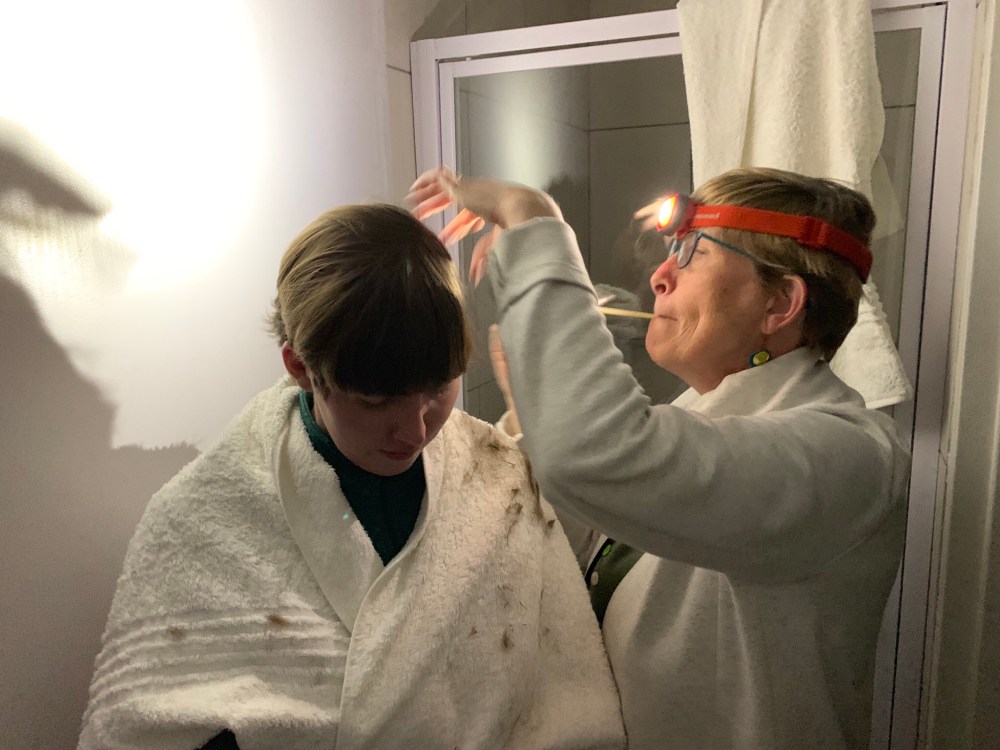
We made it in good time to Butha-Buthe, the border town where we stayed another night. It was here I introduced my parents to the most popular of all fast food in Lesotho, loved by everyone. Welcome to KFC. Yes, that KFC. Kentucky Fried Chicken. Lesotho may not have McDonalds or Taco Bell but boy do they love their KFC. We enjoyed eating our takeout in our room, too exhausted to spend any more time exploring. We did however have one more project for the night. Mama cut my hair! She trimmed it up and actually had it style, a lot more than I can do looking in a mirror cutting it myself. Now it’s shorter and should be able to grow out a bit before I need to cut it again. Of course, it would be Lesotho without some small hitch in our plans, so halfway through cutting it the power went out and Mama has to finish cutting using her headlamp.
Welcome to Salon Lesotho:
We left very early the next morning, heading straight for the border gate only a few kilometers down the road. Back in South Africa. We drove for a bit, stopping in a small town called Clarens to pick up petite and pastries. Clarens is adorable. It’s rather like Jackson Hole in Wyoming, if anyone has ever been there. It’s cute and kinda touristy, filled with galleries and cafes and B&Bs. Also, I’m biased because a chocolate croissant has never tasted so good as it did on the nice sunny morning.
We kept driving, curving our way around Lesotho to go East. We drove through the Golden Gate Highlands National Park which surrounded the road. Talk about beautiful! We didn’t stop but we did appreciate the scenery. It took us most of the day, but eventually we arrived in Durban.
A waterfront view:
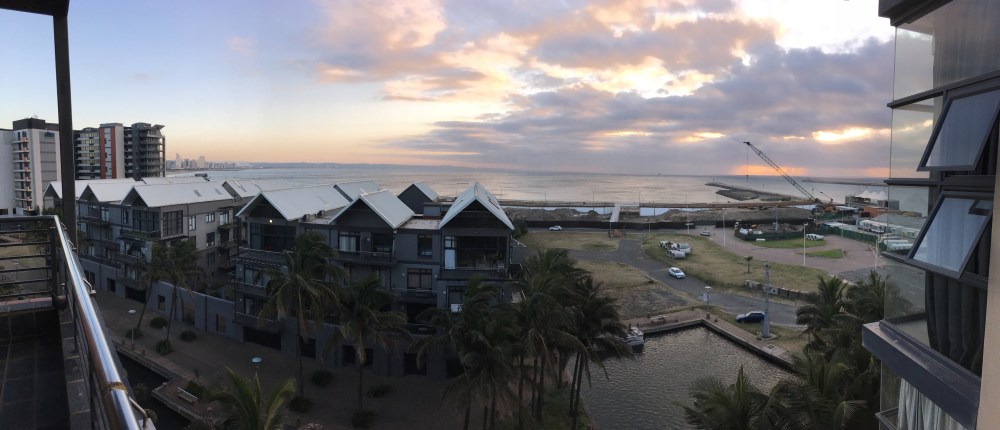
Mama has a gift for finding places to stay. It’s like her magical ability to find parking spots right by the door. And she did not disappoint in this one. We had a ritzy apartment on the top floor of a building, less that a block from the waterfront and facing the water. Now I need you all to understand something. I grew up near the beach. I was swimming in the ocean before I can even remember and I’ve been breathing in salty air my whole life. I have never been away from the beach for long. It had been 9 months since I last saw the ocean and I swear standing taking it all in against was feeding my soul. I needed the ocean and I got it. We walked over to the beach and I got I stick my feet in the water right at sunset. And now I get to check another ocean off my list. I’ve now been in the Indian Ocean. We found a place to eat at the end of a pier, and sat outside drinking cocktails on a balcony with nothing but water below us. If that doesn’t scream vacation, I don’t know what does.
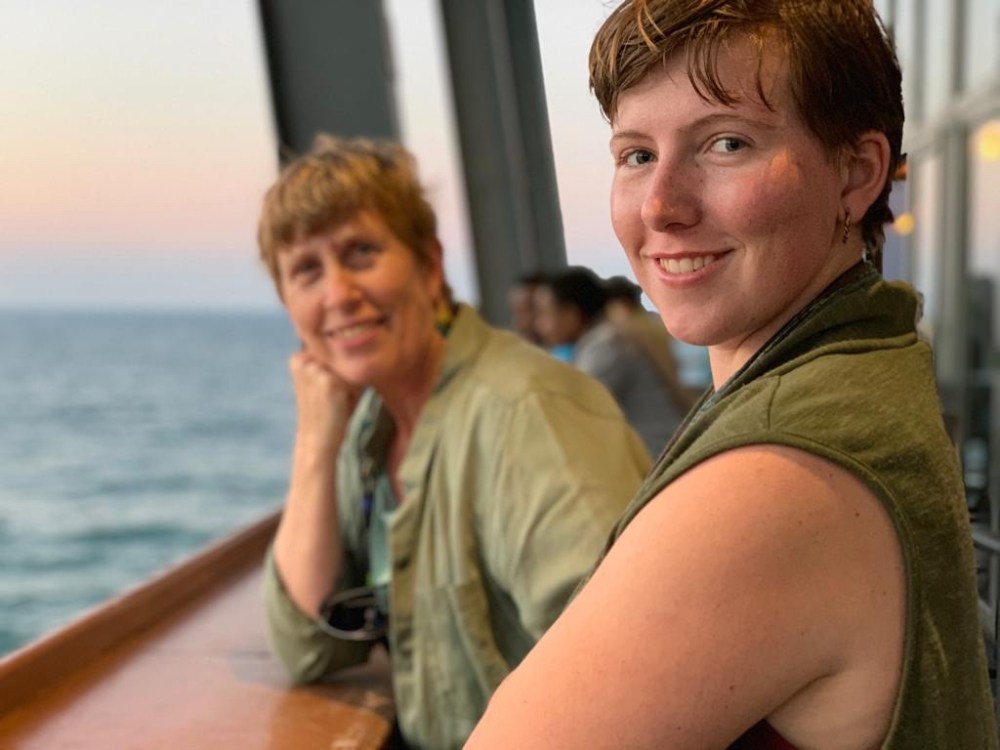
The next morning we were picked up at the hotel by the safari guide who would be driving us around for the next few days. From Durban we drove north for a few hours to Hluhluwe-Imfolozi, a large reserve in the KwaZulu-Natal province of SA. It didn’t take long to start seeing animals. Our first sighting was a herd of impala standing right next to the road, posing for us. They were not our last.
Early spottings- a male nyala and zebras (that’s zeh-brah not zee-bra):
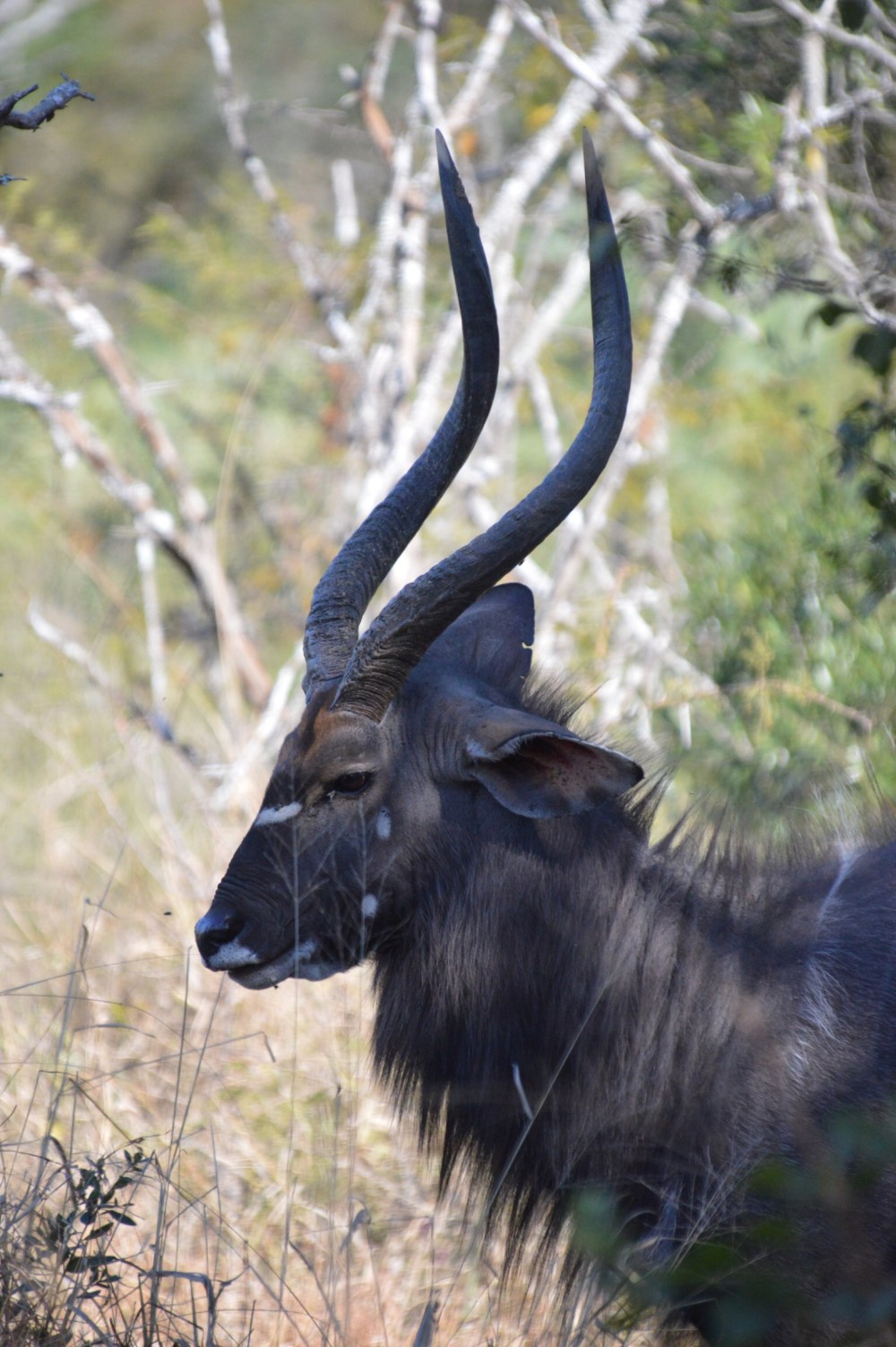
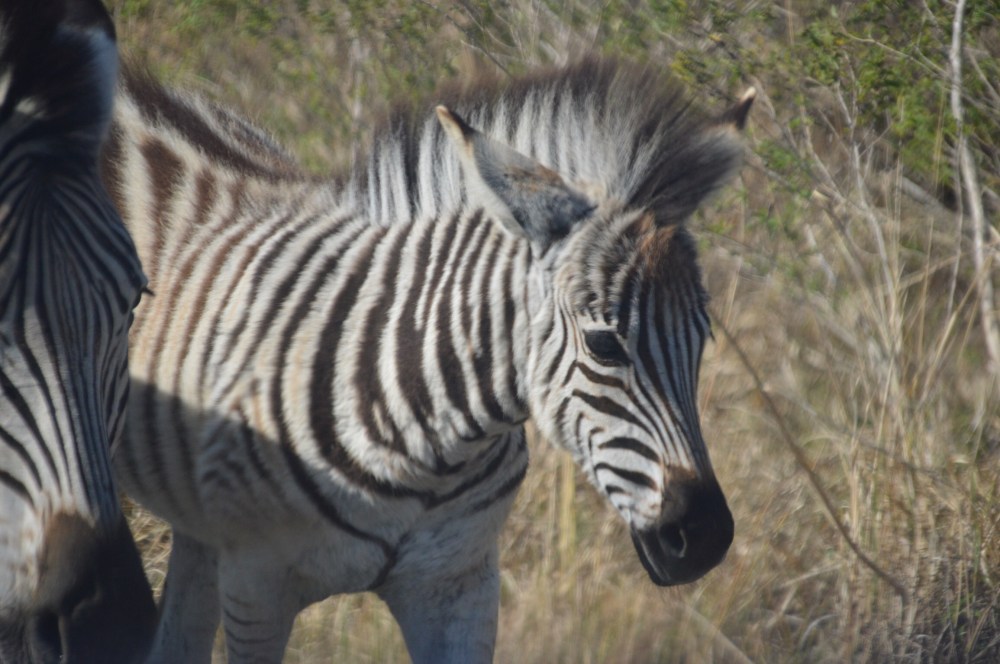
Now, unlike a zoo, you are in the animals’ habitat, not yours and so the primary rule of reserves is “don’t get out of the car”. There are a few exceptions, like picnic areas, but generally you don’t get to wander around. It is wise to follow this rule because it is amazing how animals, even the really big ones completely disappear into the landscape. We had an encounter with some full grown elephants that were hiding in the foliage less than two meters from the car and we couldn’t even see them until the guide pointed them out. And might I mention that elephants are big and really quite scary when they are standing right there in front of you. More on elephants later.
The first afternoon, we drove around a few hours and got a taste of the kind of animal life the reserve offered. We saw more impala, some nyala, wildebeest, zebras, a giraffe in the distance, and even a few rhinos. Rhinos are the primary target for poaching in the area. The elephants we saw are a type that have smaller tusks and so are not as valuable to poachers. Rhino horn on the hand… It was very interesting to see the camo-wearing gun-toting rangers around. A law has passed that poachers who are caught go to jail for 30 years. As such, most poachers will attempt to escape the authorities by any means possible, including shooting at the rangers. So the rangers tend to be in the mindset of shoot the poachers first. It’s a high stakes game and I’m glad that the South African government is trying so hard to conserve their endangered animals. Of course, poachers also run the risk of getting eaten by lions or trampled by elephants, which personally seems like poetic justice.
Fun with horns:

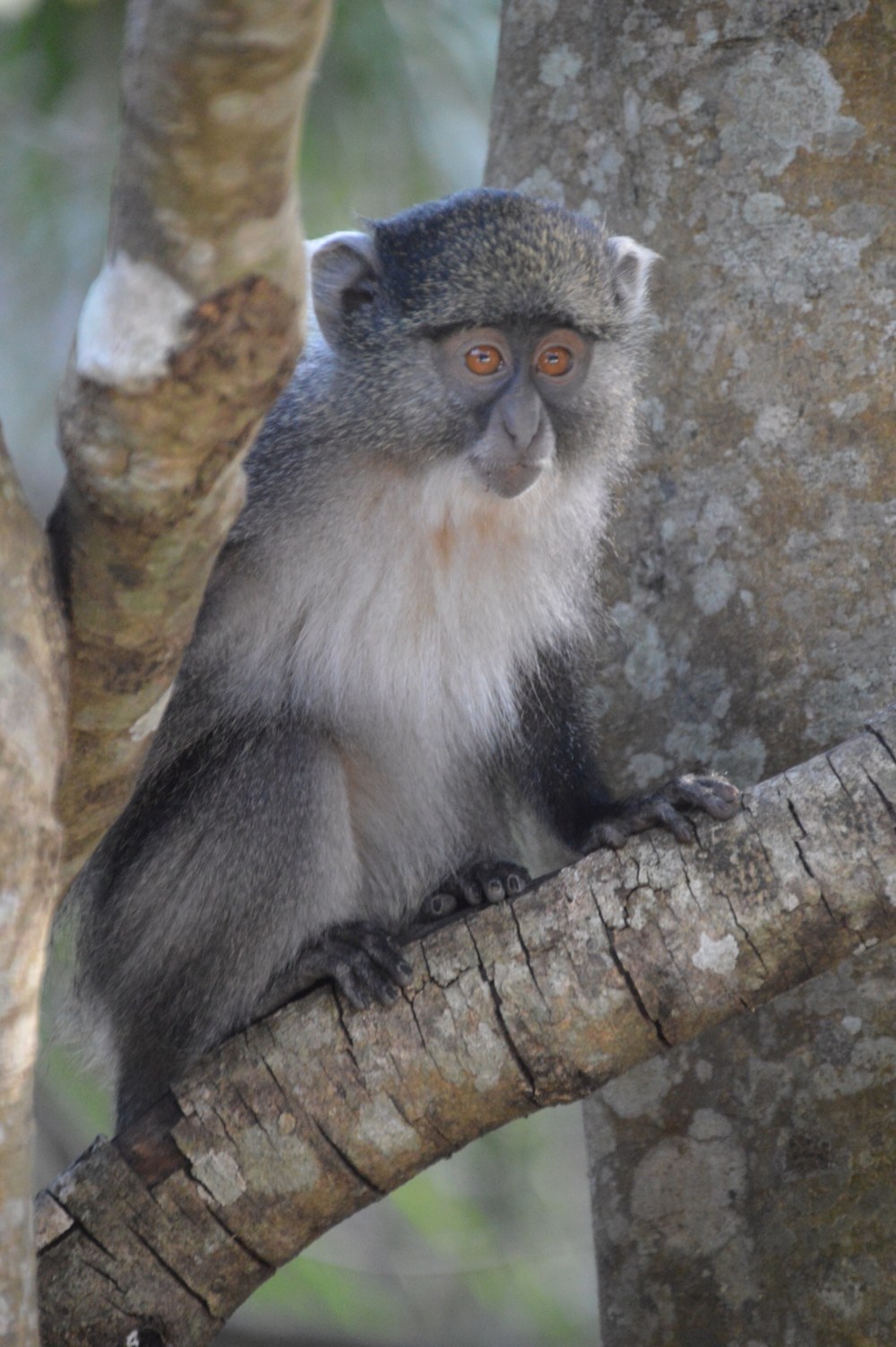
On with the safari. After a few hours of driving and taking it all in, the guide took us to Hilltop, a fenced in section of the reserve, you guessed it, on top of a hill. This is one of only two places in the reserve to stay overnight. We ended up in the grand bungalow with a great view of the park. Hilltop is also home to a very specific type of monkey that only lives there and one other forest a couple of kilometers away. They are called samango monkeys and they are adorable. They are also tricky little thieves and there are a lot of signs around the place warning you to keep windows without monkey-proof screens and all doors closed lest the monkeys get into the bungalows and munch all your food.
Primate neighbors
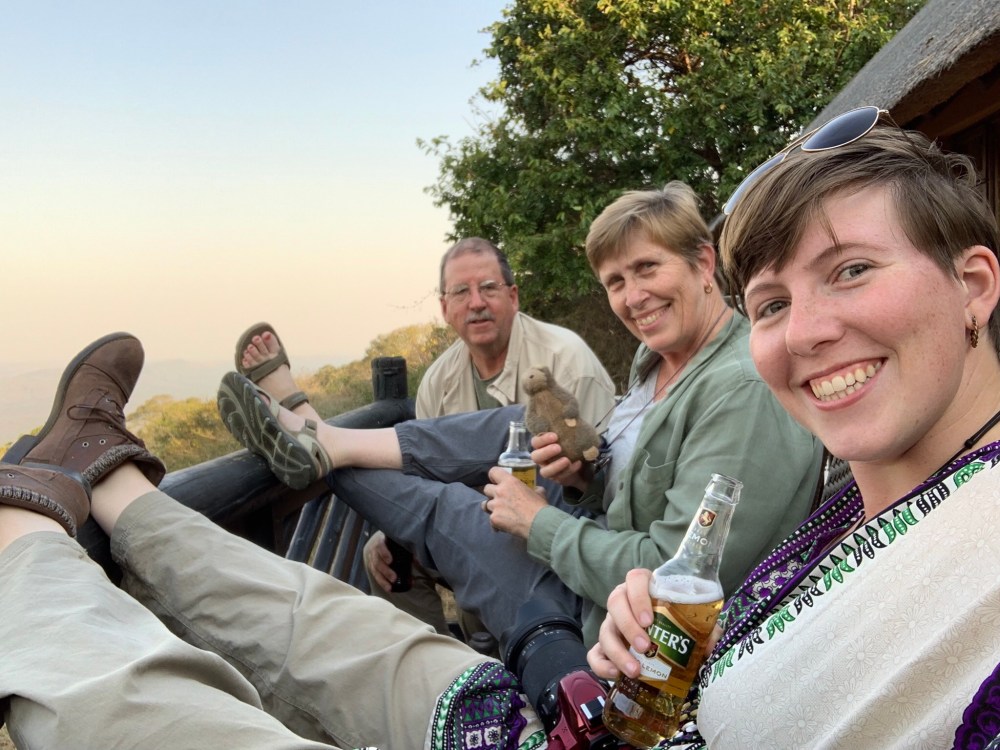
Taking in the view:
The guide had us booked on a night drive in an open air safari vehicle. There were nine of us plus the local guide and it was just before sunset when we drove off again. Three of things of note happened on this night drive. The first is that we ran into a whole pack of pachyderms. By which I mean we found a group of elephants maybe thirty strong including at least five babies. We followed them for a while as the munched their way down the road. The second thing of note is that we are rumbling down the road, in full dark now minus the spotlights on the truck. Then the guide just slams to a stop and reaches into the bush on the side of the road. Then he hands the guy sitting in the front a chameleon. How did the man see a small green lizard in a green bush at night? Magic. Or predictable biology. Take your pick. Apparently, chameleons are very territorial and this particular chameleon can almost always be found in this one particular bush. Pretty cool, right? The third thing of note is that it is wildfire season right now and the part of the park we were driving through was on fire. And we drove straight through it! 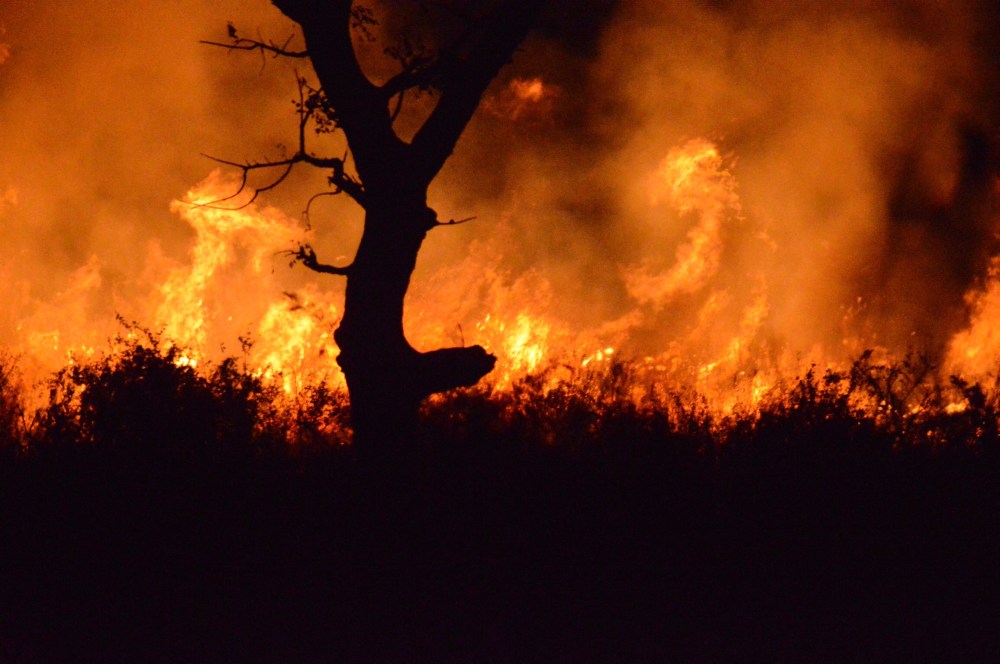
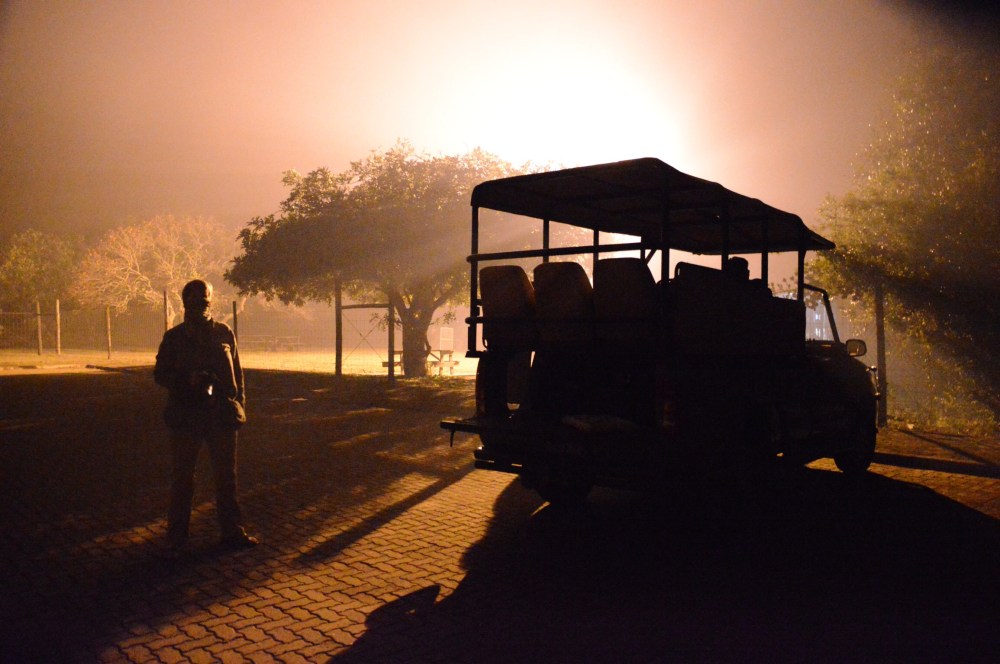
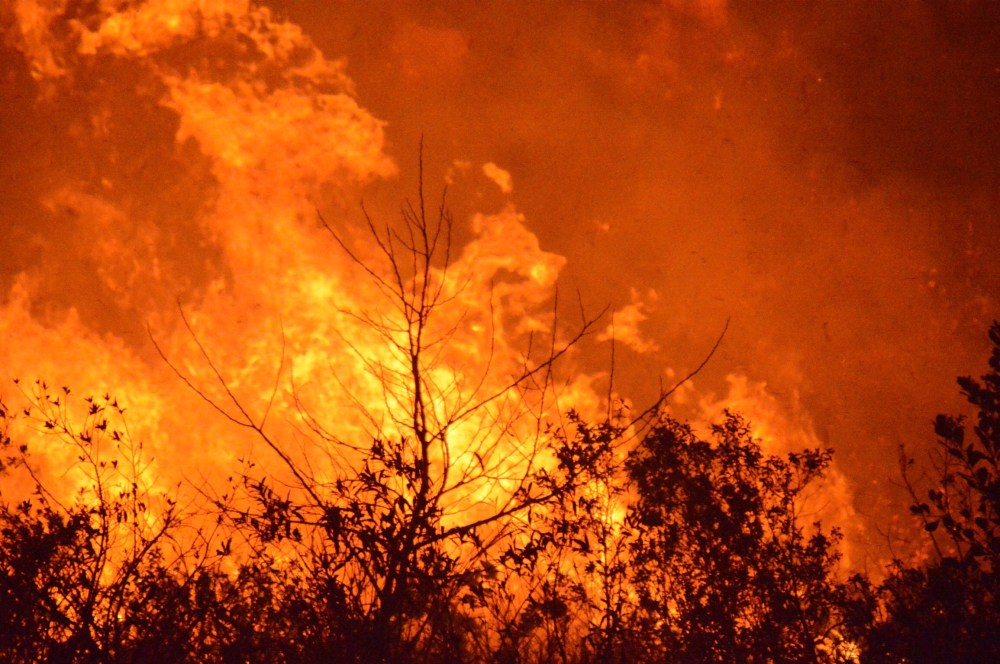 It was absolutely wild seeing the glowing fire line getting closer and then realizing that the road went straight through it. The guide didn’t even slow down. They called it a controlled burn, which clearly means something very different here than it does in America. A controlled burn here just means it’s not going to burn down anyone’s house. Being in a reserve, this wasn’t a problem and so the fire was just left to burn. Fire is part of the ecosystem and because this part of the part was mostly grass land it spread quickly and went out just as quickly. And I got some epic pictures, if I do say so myself. It was a wild, smoke filled night.
When we got back to the bungalow, our guide showed us that he had been busy at work in the kitchen and on the grill and he had made us a fabulous dinner. I hadn’t had garlic bread since coming here and I’m not gonna lie, that was my favorite part.
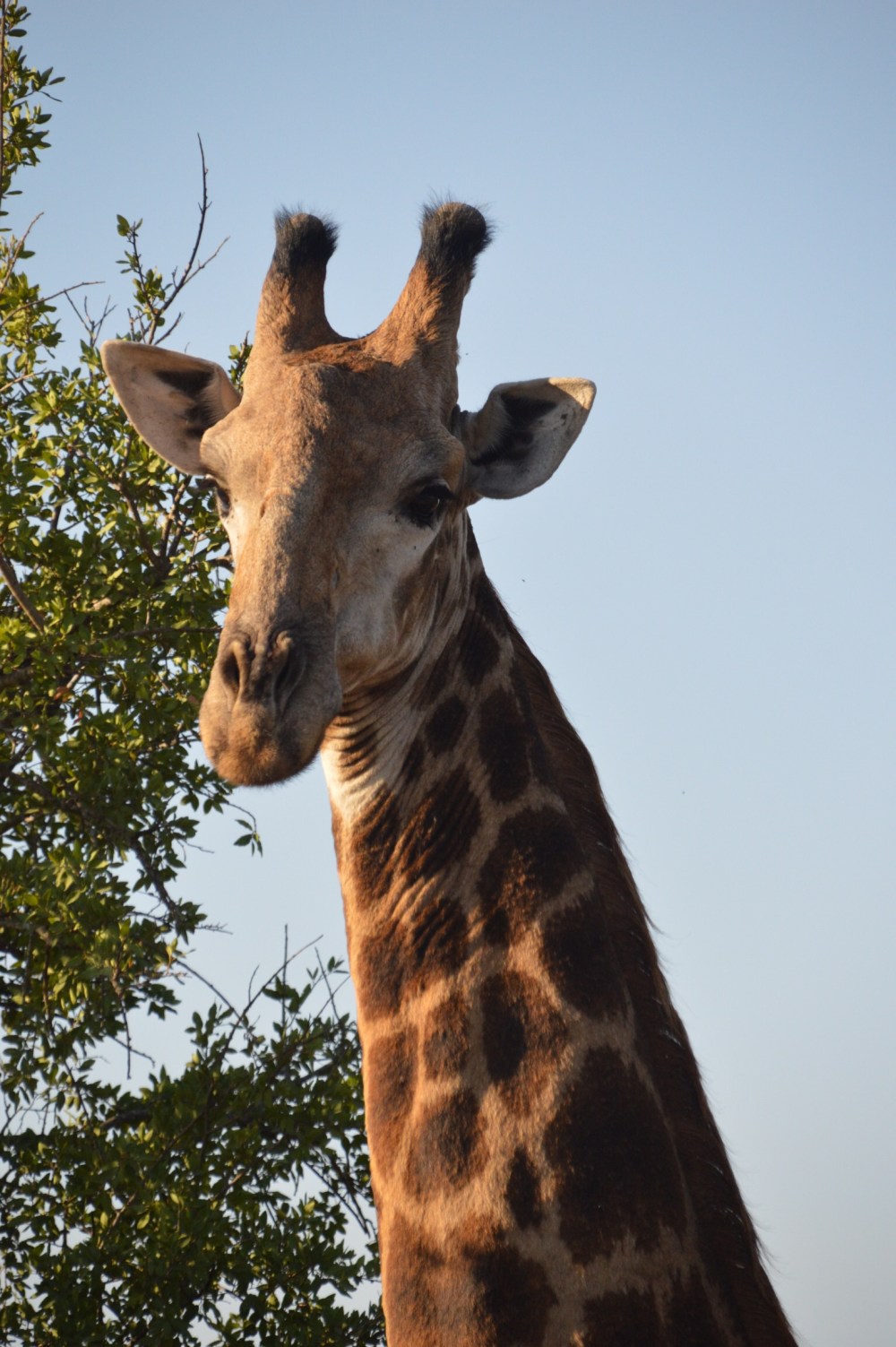
The next morning we agreed to leave as soon as the gate opened at 6 am (still dark since it’s winter) and get on the road early. We hopped in and the guide got us some nice views of water areas that the most was still curling off of. 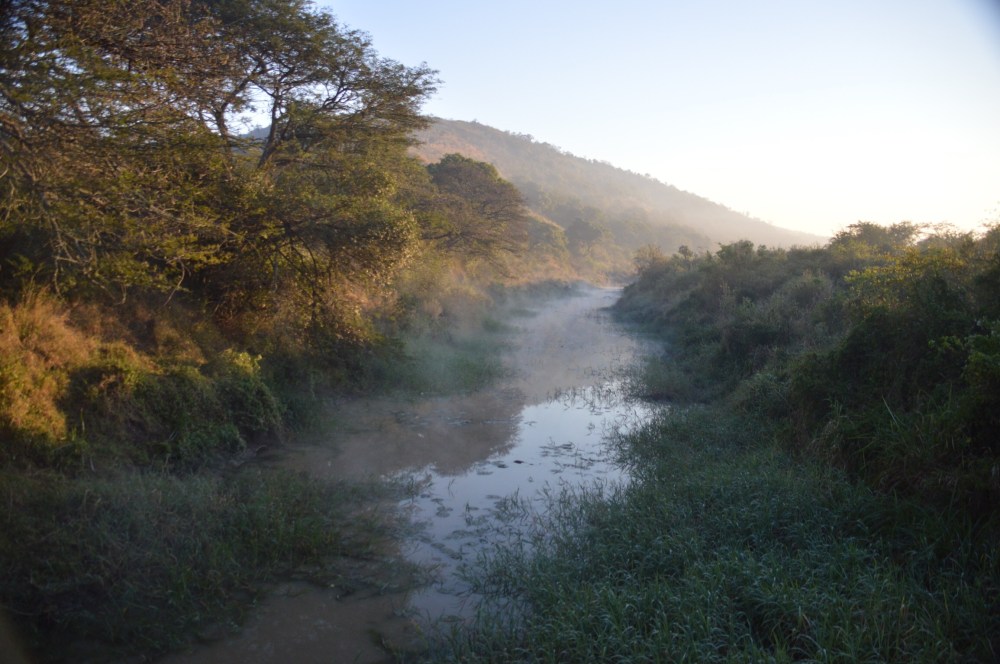 My parents are both avid birdwatchers and fortunately our guide was equally enthusiastic, helping them pick off birds from the list. The morning drive was great for birdwatching. I can’t say I share their level of enthusiasm, but it’s hard not to get excited when you see the rainbow colored Bee Eaters, among others. We went back to Hilltop for a lovely buffet breakfast and then it was back in the car, this time heading to the southern end of the park. The terrain is very different down there and so a different spectrum of animals lives on that side. Turns out that it was a great day for seeing rhinos (more in that day that the guide had ever seen in one day. We reached something like 40 rhinos either hanging solo or in pairs throughout the day. And we saw both black rhinos and white rhinos!). We also saw a whole herd of water buffalo, some baboons, and my personal favorite- giraffes!
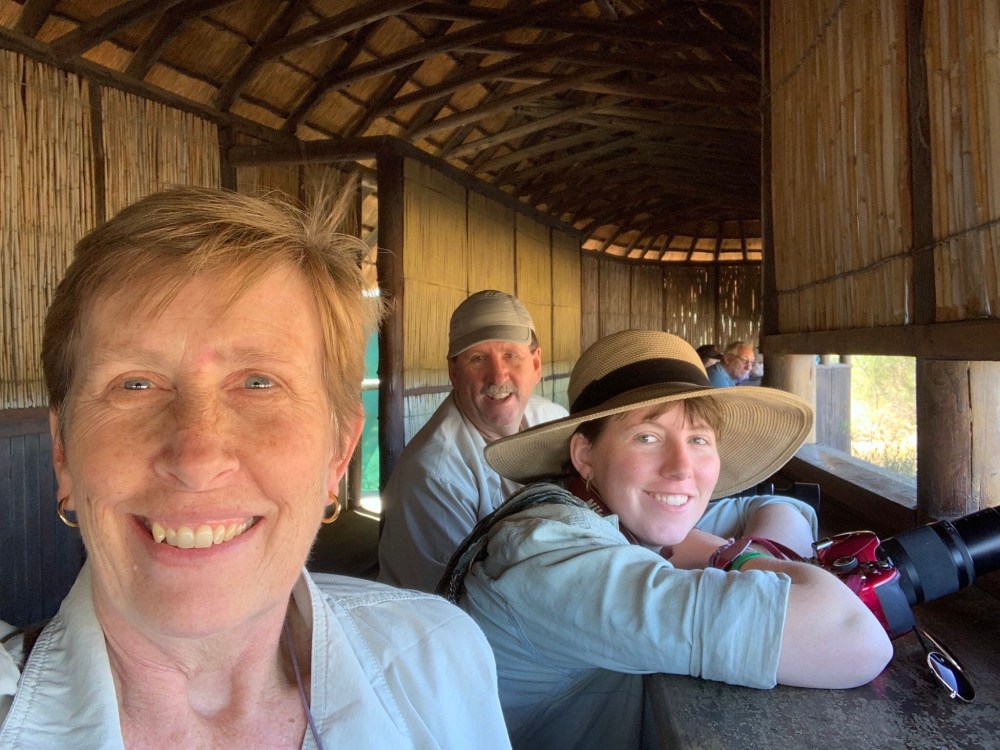
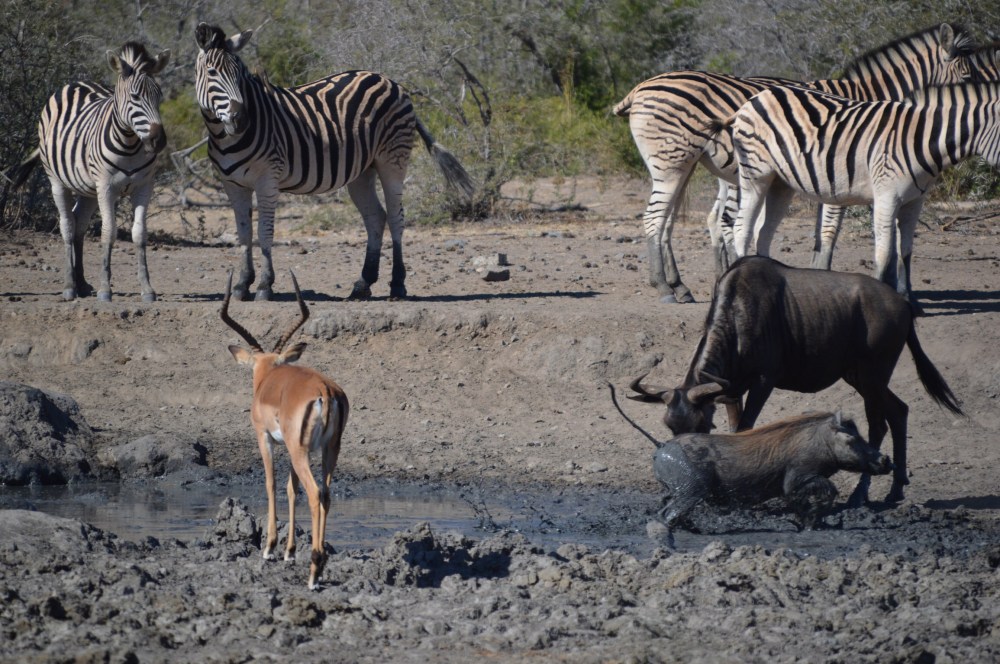
We stopped at a hide for lunch, one of the few areas we can get out and walk around. The hide is a fenced in path and a building with small narrow windows, so you can see the wildlife without them seeing you. This one was right next to a watering hole. Being winter, which is the dry season here, there was only a little water in the watering hole, but this was still the largest amount in one area for several kilometers. Being the only place to find water, it was busy. We saw zebra, warthogs, wildebeest, nyalas, impalas, and some kudu all together sharing the area. Busy day!
After eating our picnic lunch, we drove on and found ourselves at the very southern tip of the park. And that’s where we saw the lion. Or to be specific, that’s where we glimpsed the lion butt disappearing into the bushes. We drove around the area for another half an hour or so, trying to cut it off but we never saw it again. Our theory is that is moved off the road when it hears us coming and immediately flipped back down and went back to sleep. Remember what I said about not being able to see wildlife even a few meters off the road, well try it when it’s the same color as the grass and lying down. Oh well!
We had to race back to Hilltop before the gates closed at 6 pm, which was a few hours of driving from us at the time. We were making good time and would have made it by probably 5:15. But you know how it goes- the moment you have to get somewhere is when you run into that obstacle that is determined to make you late. In our case that obstacle was a pair of grumpy bull elephants. See? I told you I’d talk more about elephants.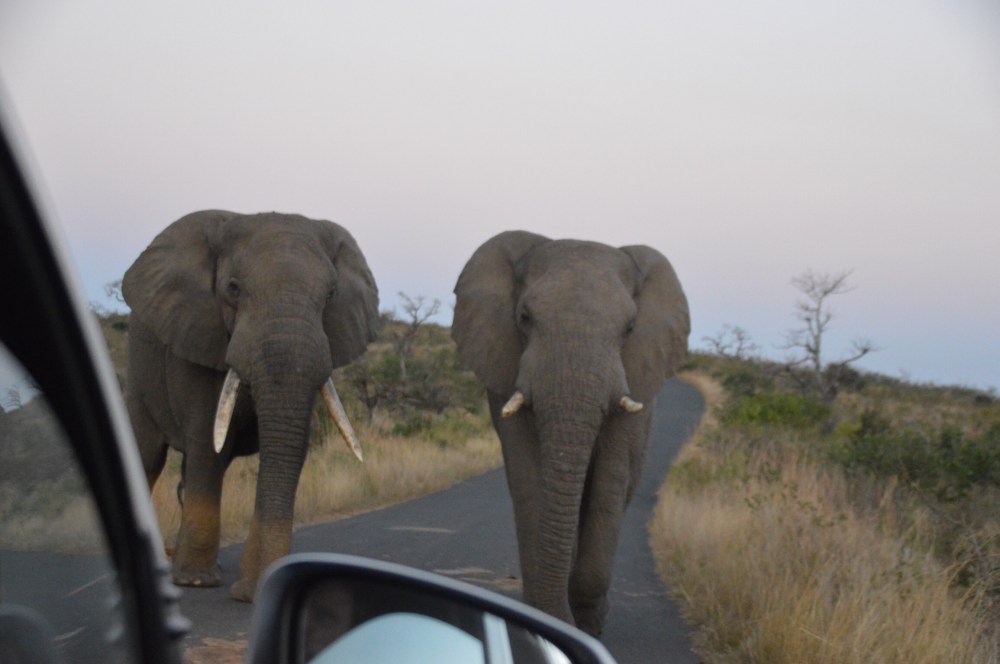 Well, this pair of big boys were enjoying grazing on the road and they did not care to move for us. Seeing as elephants can flip a car with minimal effort, the guide made the wise decision to not push them too hard. He revved the engine just to see if they’d move. But these guys decided instead that they didn’t like us. So they started walking toward the car, at which point the guide promptly went into reverse. These elephants bullied us backward down the road probably about 2 kilometers. Finally we reached a section with a little triangle interaction we backed up the dirt road and the elephants decided to follow. Then we went around the other two sides of the triangle quickly and by passed them. We sped up the single paved road to Hilltop as fast as possible (not very fast since you don’t want to turn a corner at night at suddenly run into a rhino crossing the road, or another elephant). We made it back at 5:58. Nailed it!
After breakfast the next morning, we left Hluhluwe-Imfolozi behind and drove east toward the coast. Our first adventure of the day, a reserve dedicated to raising and rehabilitating big cats. Unlike the safari park, this reserve is more zoo like, filled with pens for the cats. Because these animals are only meant to be there temporarily, they don’t have as much room to roam. Of course, like with any program of this kind, there are always a few animals that are judged unfit to ever be released into the wild. Some of these we got to meet. They focus on four types of cats. We got to enter the pens with all of them. First we got to meet African Wildcats. They look remarkably like domestic cats, mostly tabbies, except bigger. The funny thing is that they are the only big cat capable of interbreeding with domestic cats and in Lesotho where the wildcats still live in the wild, they do just that- breed. A lot house cats in Lesotho are partially African Wildcats. Back in October I made a post where I introduced another volunteer’s kittens. Turns out those kittens’s daddy was a wildcat because those kittens grew up to be very large cats.
The next cat we met was a caracal. They look sort of like a mix of a lynx and a mountain lion. Beautiful creatures! The next ones were serval cats, a pair of brothers that were basically domesticated by the time they had been brought in and were permanent residents of the reserve. I got to pet one!! Their spotty fur looks soft but it’s actually quite coarse, which really makes more sense from and evolutionary standpoint. Lastly, we got to meet the cheetahs.  Cheetahs have always been one of my favorite animals so this was particularly thrilling for me. Another pair of brothers, these two were also permanent residents and very used to humans. And like cats everywhere, they mostly ignored us and napped. We couldn’t pet them but we could stand really close and get pictures with them. Logically I knew how big they are and of course I’d seen cheetahs before in zoos but they still surprised. They are big animals! I definitely wouldn’t want one of those guys pouncing on me. A human wouldn’t stand a chance. Another fun reminder not to mess with nature. If she ever decides to mess back, humans will definitely lose.
After big cats, we drove to a small town called St. Lucia. It is very touristy, but undeniably cute. We checked into our hotel and had a few hours to relax. Naps were taken. Near sunset, we headed down to the river just next to town. We had been booked on a sunset cruise of the estuary. We sat on the top deck of the boat, a perfect vantage point for spotting hippos and crocs. 
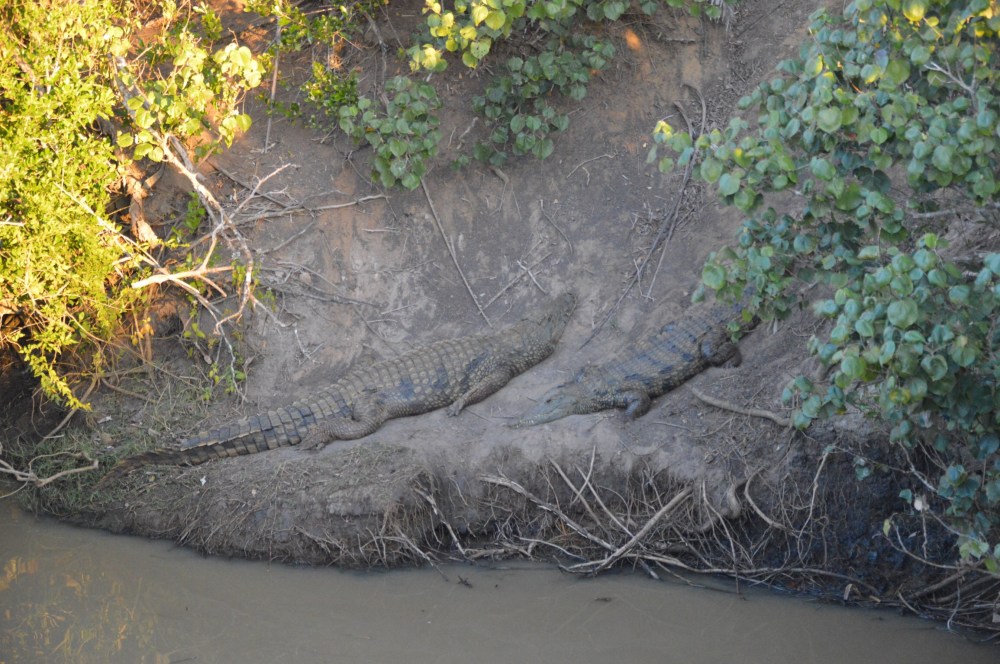 Ready for some cool facts? I hope so, because I’m going to tell you anyway. To start with, this estuary system is the largest in Africa, spanning some hundreds of kilometers with a series of interconnected lakes and rivers. Second, none of it is actually connected to the ocean any more, since about 30 years ago it closed off (naturally not because of human stupidity). Third, this sudden enclosure of the lake system makes for a very interesting mix of aquatic animals. I already mentioned hippos and crocodiles, but I didn’t tell you that the river getting closed off from the ocean also stranded a bunch of sharks. A lake filled with hippos (the mostly deadly animal in Africa), crocodiles (do I really have to explain that crocs are dangerous?) and sharks. Not somewhere I’d ever go swimming. The last fun fact I’ll give you came from the guy driving the boat. He pointed out the vast number of trees growing around the lakeshore. He said that there are approximately 400 native types of trees in the estuary/lake region. He then pointed out that this was particularly impressive because the entirety of Europe has 75 native tree types. Big difference!
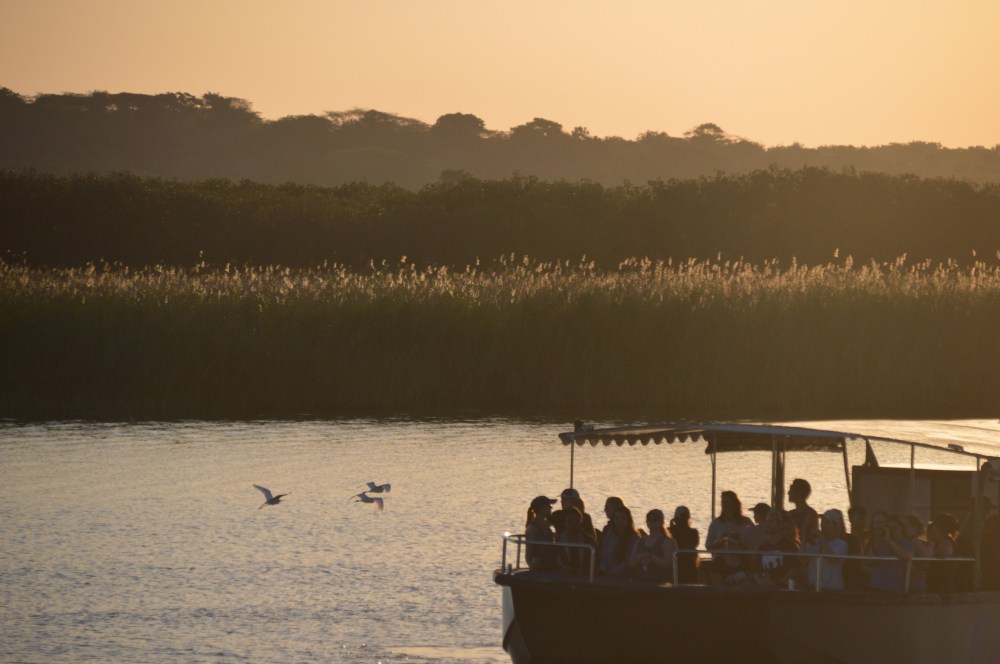
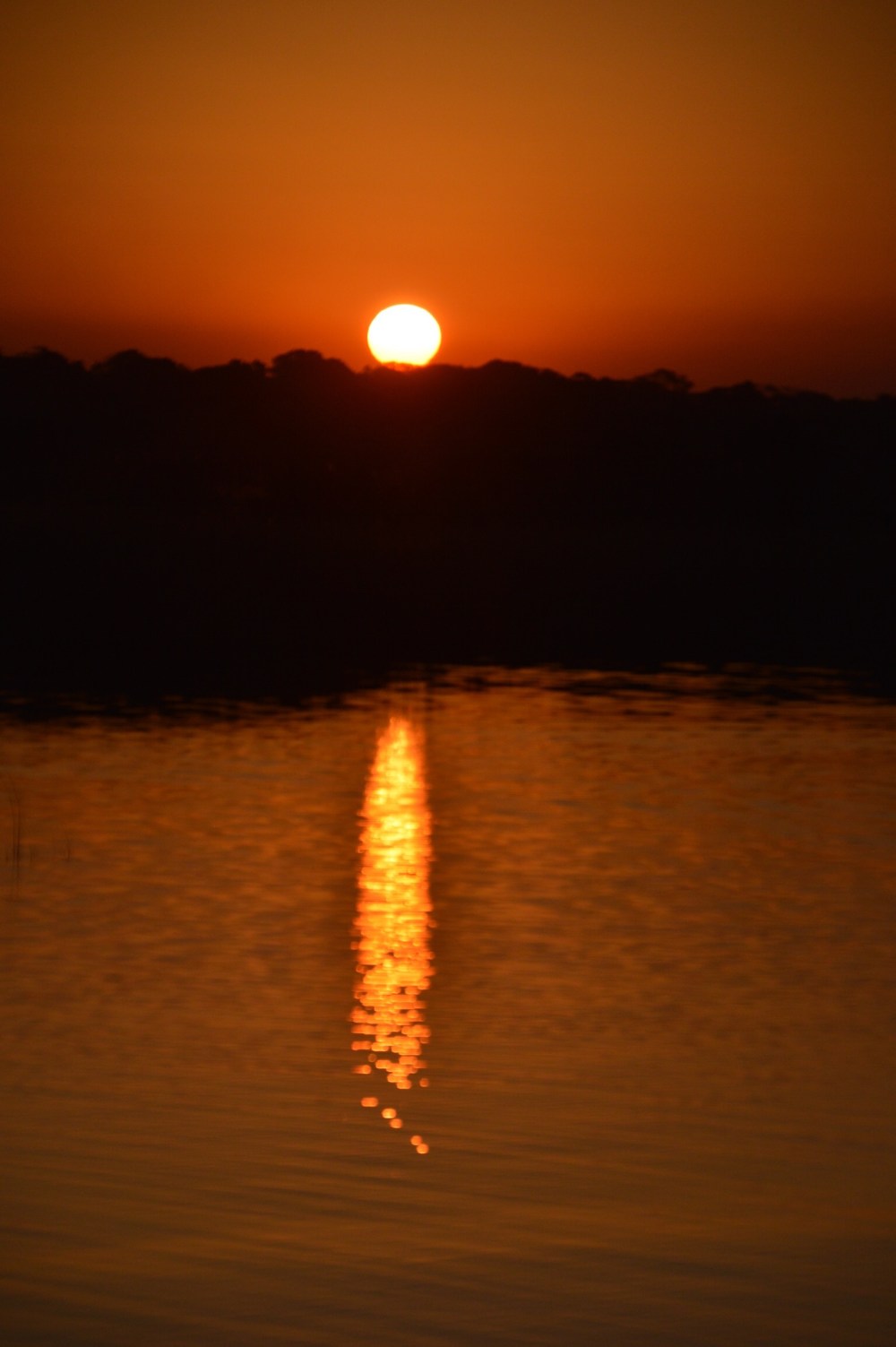
We saw lots of hippos and few crocodiles (no sharks) in the cruise, getting quite close at times and able to get some great photos. The dock was in sight when the sun finally slipped below the horizon, giving us a great ending to the two hour ride. Then we went into St. Lucia for dinner and I got to eat sushi for the first time in months! Seafood isn’t big in a country with no coastline so I don’t really get the chance, ever. Our guide, who was fantastic if I haven’t mentioned it, gave us another surprise (in addition to he night drive and the the cheetah park and the boat cruise, none of which we knew about in advance). He offered us the chance to go snorkeling the next morning in yet another reserve, this one running up the coastline from St. Lucia. We all thought that sounded like an awesome way to spend our last morning on the safari trip.
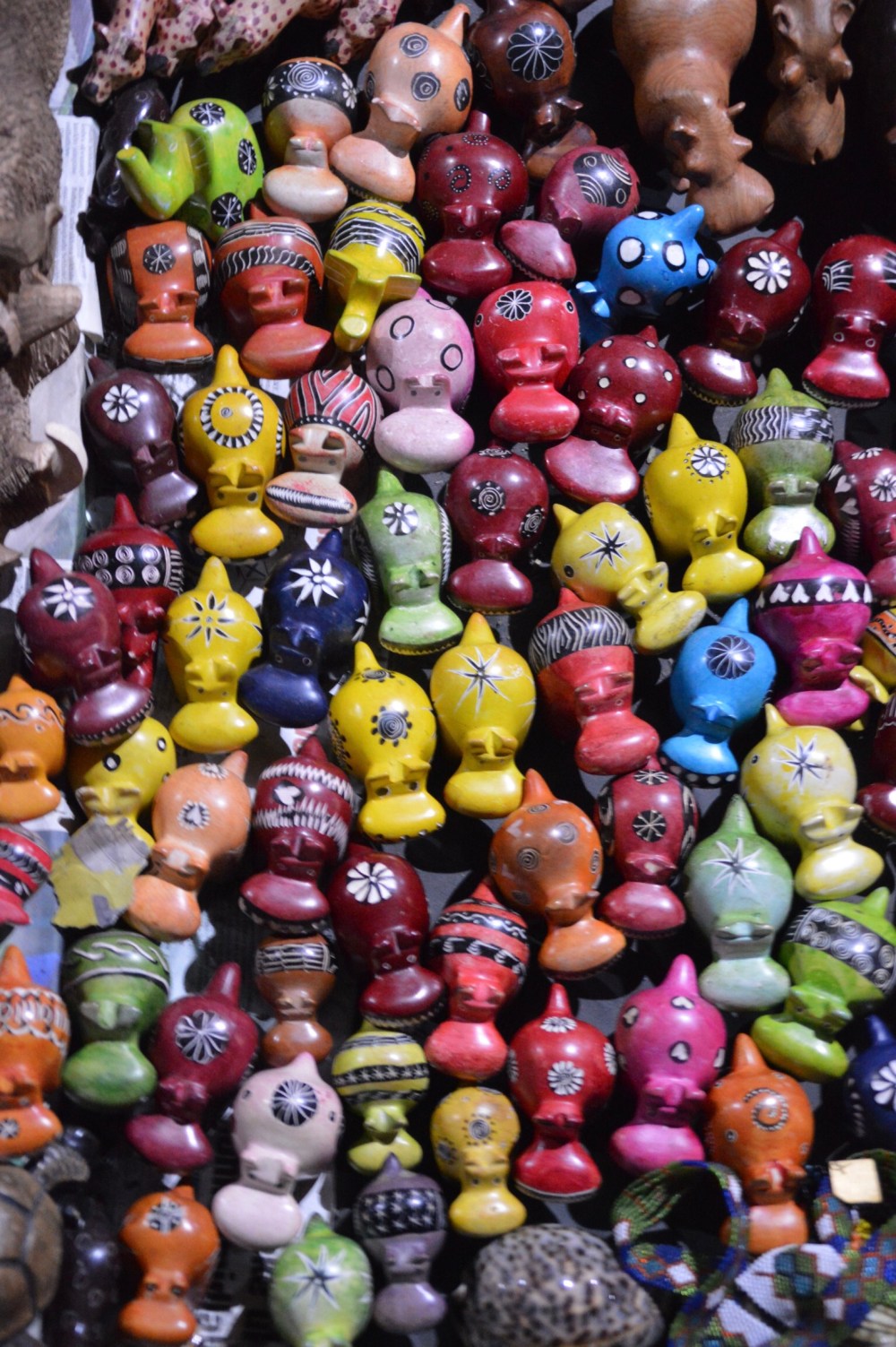
Before we returned to the hotel, we wandered through and open air market along the street. Every stall sold basically he same stuff, but it’s hard to complain when that stuff is all locally made art. The sellers are aggressive in their enthusiasm to make a deal. We did not make it out unscathed. Mom bought a few small flat things that would fit in her suit case and I bought to very colorful tiny figurines, one of an elephant and the other hippo (they are adding to a growing collection I have back in the states, gifts from friends and family in their travels to to Zambia and India). They will love with my in Lesotho for the next year and a half before joining their brethren. 
The next morning we set out with our rented snorkel gear and drove through yet another reserve. Because this one backs into the ocean, it has a much more tropical feel, because there is so much more water. Dense forest surrounded the road at many points and it was easy to imagine leopards and the like living in secret in the dark leafy mess. Eventually we popped out of the forest into Cape Vidal, the beach in the reserve where we were allowed to go swimming. Because they clean in nearly every morning, this is cleanest beach I have ever been on. No trash to be seen. Wouldn’t it be nice if all beaches could look like that?
Now it may be winter, but at sea level it’s still quite a comfortable temperature, plus the water is circling down from India so it’s quite warm water. In fact, it was rather perfect weather for a morning swim. Already wearing our swimsuits we headed out to a spot if rocky tide pools that curled around the southern side of the beach. We piled our stuff on the rocks and jumped in. I have never seen so many colorful fish outside of an aquarium! There must have been at least a few dozen different kinds. I also a huge crustacean with antennae that must have been at least a foot long. The water was a bit choppy which kicked the sand up and made it a little hard to see sometimes, but overall it was amazing and we saw so much. It made me really wish I knew more about fish! After about an hour of diving around the rocks, we headed back in, salty and happy. Talk about a great finish!
I have no fish pictures because my GoPro ran out of batteries, but I do have beach pictures: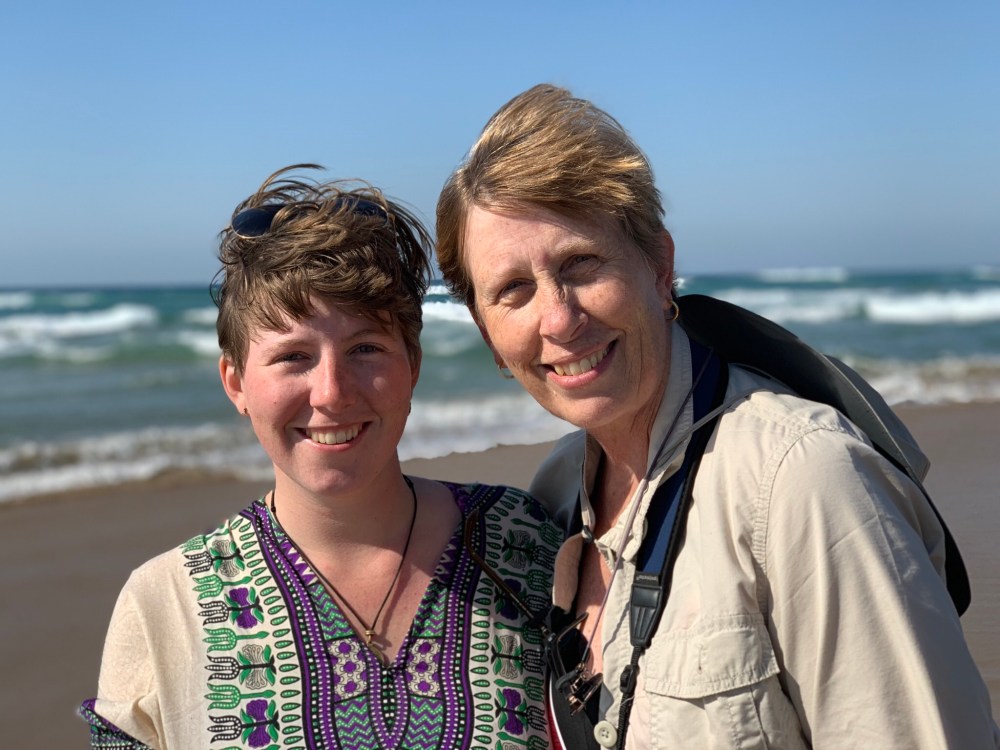
The last thing we did before our guide drove us back to Durban, was stop at a lookout tower to eat lunch. The tower is a basically a treehouse that overlooks the lake on one side, the ocean on the other, and the plains and forest all around. It’s one heck of a view for a lunch spot. We even spotted a whale!
Then it was back to Durban. The guide had been fantastic and we were a bit sad to see him go. The whole trip had been incredible and impeccably planned to the last detail. The guide and his bosses knew their stuff. If anyone is ever in SA and wants a really well done safari tour, hit me up and I will recommend their company.
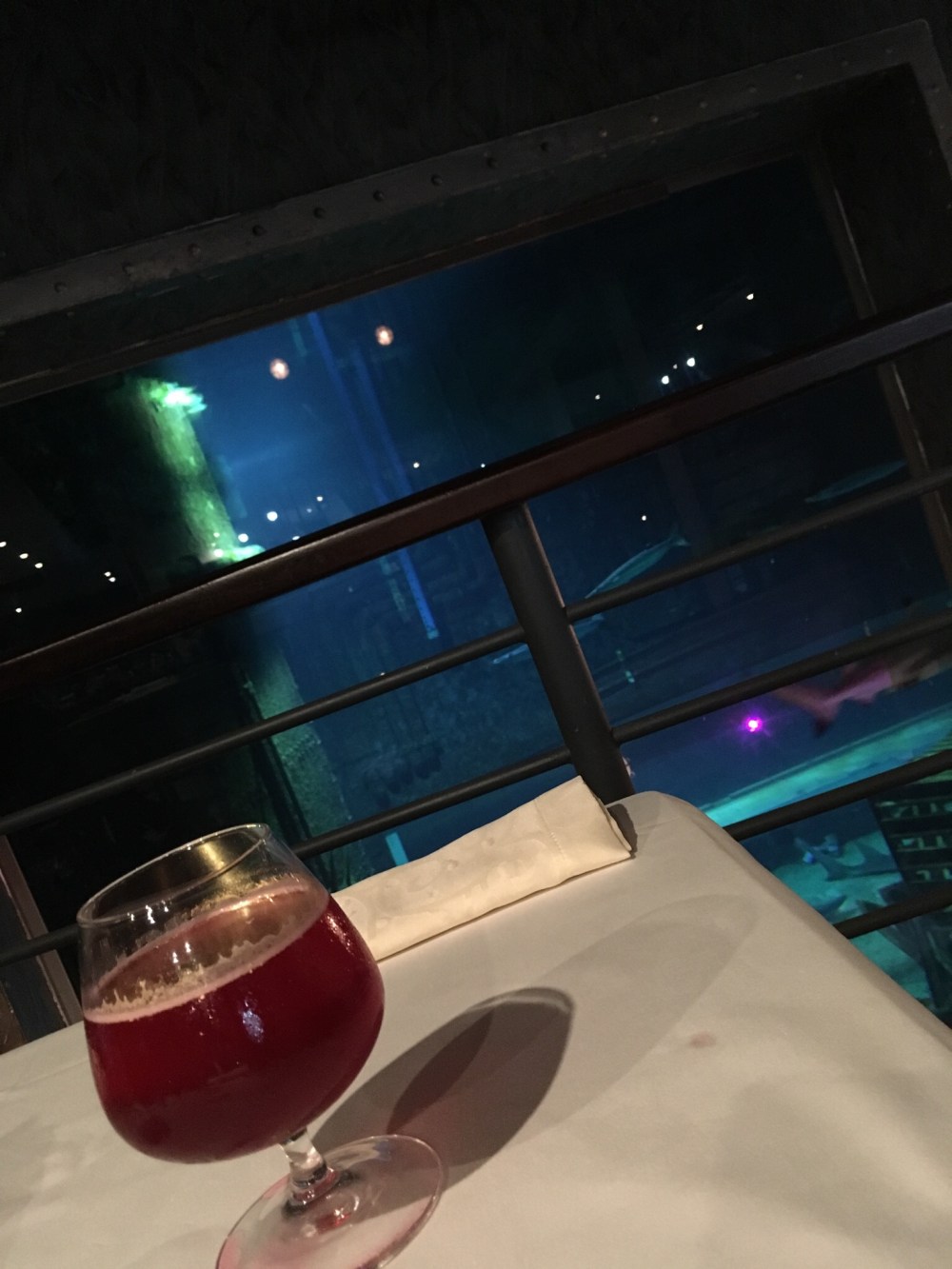
Now, I forgot to mention that this day was also Mama’s birthday! So as a parting gesture our awesome guide made a reservation at restaurant near our hotel. And this is going to take some explanation. The place we were staying (the same one as the first night, just a different room) was about a ten minute walk from Ushaka Marine World. And around the outside of Marine World is a horseshoe of shops and restaurants. And then, at the end of this mini mall, where it runs into the beach, is a ship. A big old ship brought onto land as part of the Marine World landscape. And it has a restaurant inside it called the Cargo Hold. This is where we went for dinner. Why would a restaurant in the basement be of interest when we could be sitting staring at the ocean at a different restaurant? Because the Cargo Hold butts up against the Marine World shark tank. We spent our evening sitting drinking cocktails and eating fancy food right next to the glass as sharks swam by. It was awesome!
That’s gold dust on our drinks. Overkill- Yes. Worth it- also yes! also sharks!
So that was our time in South Africa. Almost. We still had to get back to Lesotho! The next morning we left early and drove for the border, but not the one we came out of. This time we were aiming for Lesotho’s most infamous and most difficult border- Sani Pass. How is a border difficult, you ask? Let me explain. 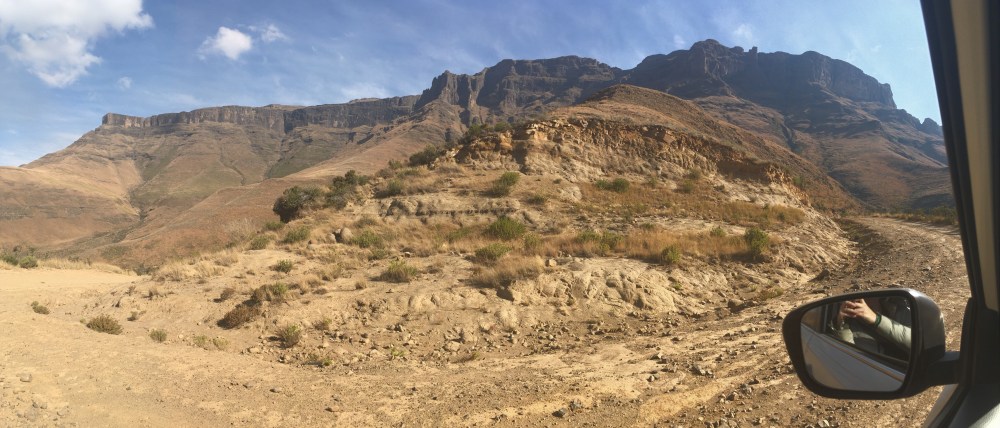
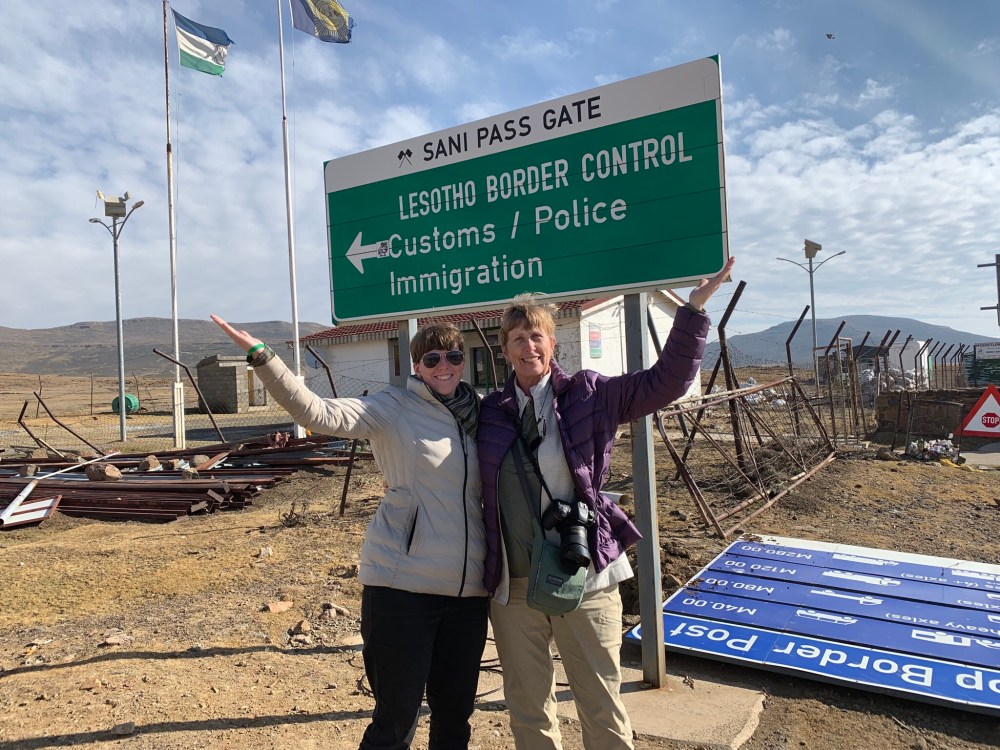
The eastern border of Lesotho runs the ridge line of southern Africa’s most dramatic mountain range, the Drakensberg mountains. I happen to live in the western and somewhat tamer reaches of this same range. The Eastern border is basically a set of thousand foot cliffs and drop offs. And Sani Pass goes straight up the only “accessible” area for several hundred kilometers in either direction. Of course, accessible here has the meaning of illegal without a four wheel drive and precarious on the best of days. We had been worried about snow closing the pass, but there hadn’t been enough so we decided to chance it. You know how I laughed about people saying that the road to Katse Dam was horrible, but they had never been on my road. Well, Sani Pass makes my road look neat. The South Africa border post is at the bottom of the mountain, and that is where they stop you if you don’t have four wheel drive. The Lesotho border post is at the top. That means that there’s this awkward hour and half of driving where you have been stamped out of one country but not stamped into the other. No mans land. Kinda weird. Basically, it is a terrifying road that should only be attempted by very confident drivers with four wheel drive, good tires, and a high suspension. But it is absolutely worth it for the views!! Breathtaking. Beautiful, gorgeous, wish you were here! (Inside joke- brownie points to anyone who’s seen French Kiss and gets my reference).
At the top is Sani Pass lodge and bar, a proud establishment that gets to boast the slogan “the highest pub in Africa”. So naturally we stopped and got a drink!
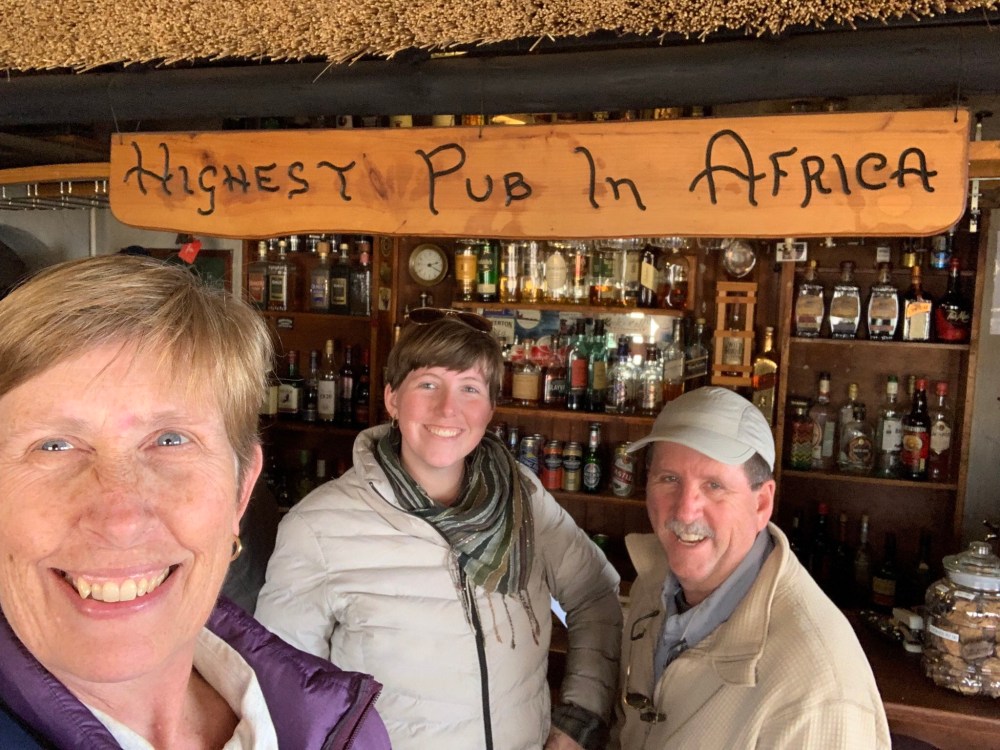
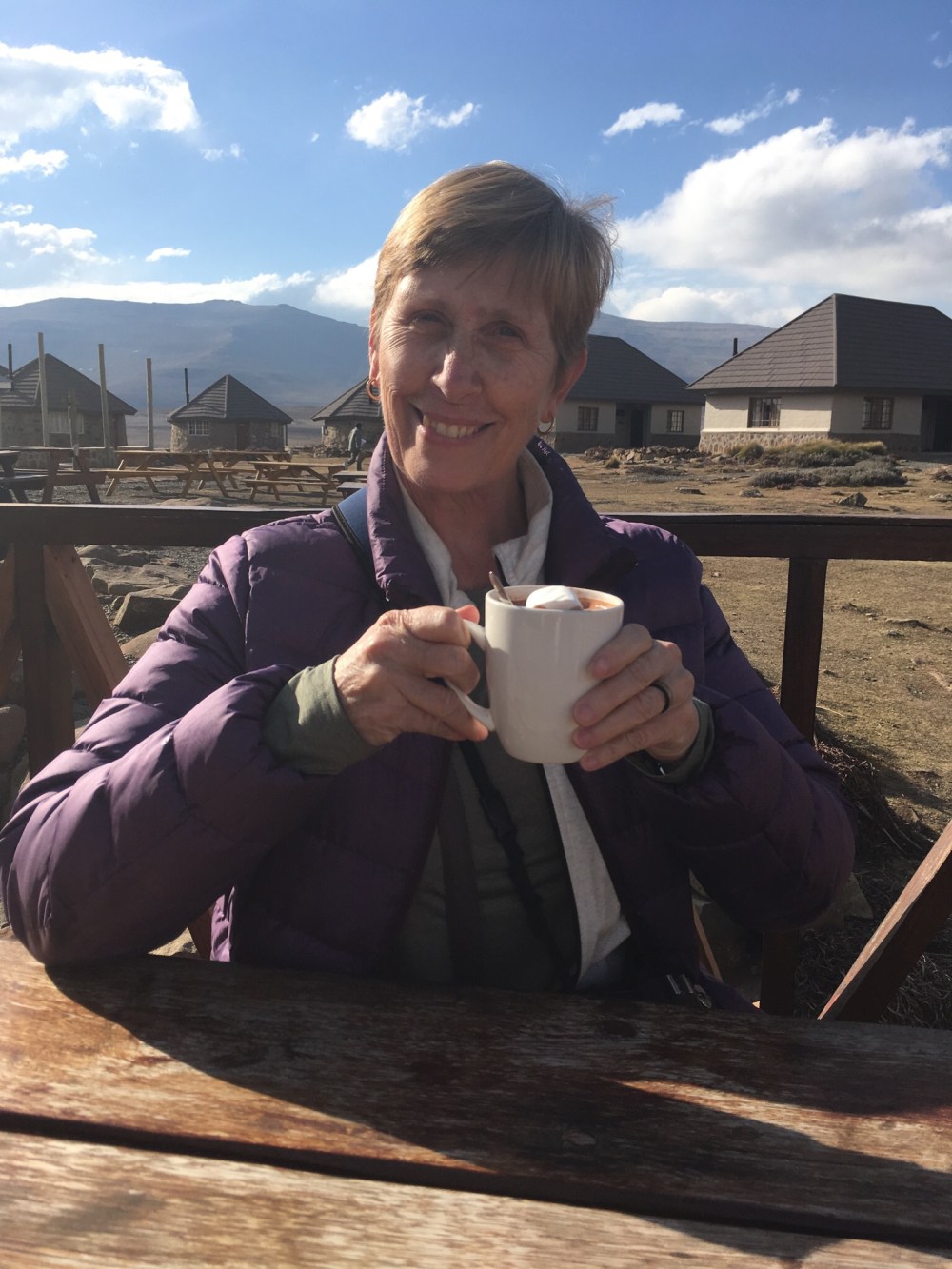 We sat outside which was good because it was very crowded inside but bad because it was 1 degree Celsius outside (about 34 degrees for you folks in Fahrenheit). Good thing Mama and I chose our drinks to actually be spiked hot chocolate. I missed the season’s first snow while I was playing at the beach and there were a few patches still in the ground as we drove all the way to Thaba-Tseka from Mokhotlong, another not great road (more like mine and not Sani though). We arrived after dark but at least we knew the last hour of the road. And that was it.
We spent one last night together before my parents drove me and the groceries they had bought me to my house in the morning. Then they left me there and drove back to Maseru. Of course, they went spent another week and half doing another safari in Tanzania without me and made me incredibly jealous by constantly sending me their pictures of baby cheetahs and lion prides and whatnot. Thanks a lot. So that’s it, my epic safari tale! Check that off the bucket list!
P.S. I will be posting a few smaller, none safari related posts in the near future. I didn’t want to detract from this adventure by including other stuff.

 Mountain Tales