Get ready for some fun facts! Here we go.
Fun fact number one: I have an astronomy degree and you have to put up with some getting stellar education right now. Actually I suppose you don’t. You could stop reading if you really wanted to.
Fun fact number two: Lesotho is in the Southern Hemisphere and that means some pretty neat stuff is going on in the night sky here. In fact, as someone who has never been to this half of the planet before I moved here, this was some of the stuff I was most excited about.
3… 2… 1… Blast off!!🚀
We live on Planet Earth which is in a small star system on the outer reaches of one of the spiral arms of the Milky Way galaxy. Most of this is fairly common knowledge. Here is what isn’t. Earth is tilted so that The Northern Hemisphere faces toward the edge off the galaxy. This means that we can see some of the arm that we live in and then we can see the universe beyond. The Southern Hemisphere however is tilted to face the center of our Milky Way galaxy. This basically all means that the Milky Way visible in the night sky in the Southern Hemisphere is a lot brighter and more distinct that it is in the Northern Hemisphere. Here, I get to stare at the center of the galaxy. Pretty cool, right?
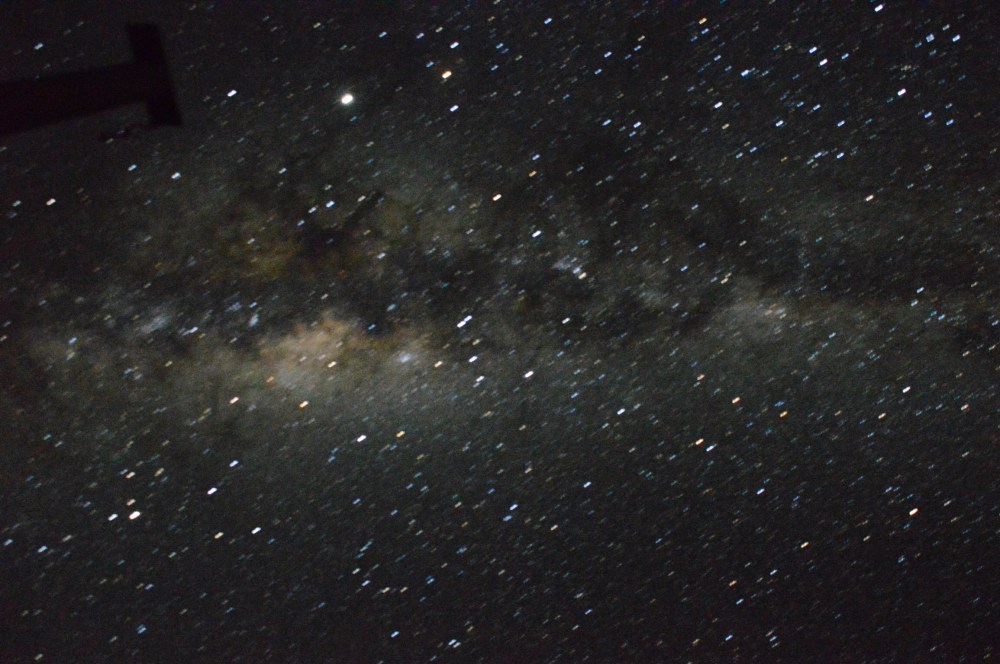
Fun fact number 3: Not only are there a lot more visible and bright stars in the sky when you face toward the center, but there are also massive dust clouds in space that actually block out some of that light. These show up as dark patches outlined by the glow of a few million concentrated stars. They are called dark constellations, something the North has no equivalent to. They are constant and distinct. In fact, they are so distinct, that some ancient civilizations in the Southern Hemisphere actually had names and mythologies attached to these dark constellations, the same as they did for the brighter cousins made of stars. I had only ever heard about and seen pictures of dark constellations. Now I have some pictures of my own!
I love photography and as such I am always trying to improve. This is the best of my first batch of successful star shots. There are still a few glitches to work out before I am completely satisfied, but still, I am very proud of how it worked out.
30 second exposure on my Nikon D3200:
Happy star gazing!

 Mountain Tales